

Sliding Flood Gate for the Stephenson Street Flood Scheme
MM Engineering designed and manufactured the 9 m sliding flood gate that closes Corporation Road on Natural Resources Wales' £25m Stephenson Street flood scheme in Newport. It was designed for one operative to deploy, including in high winds.
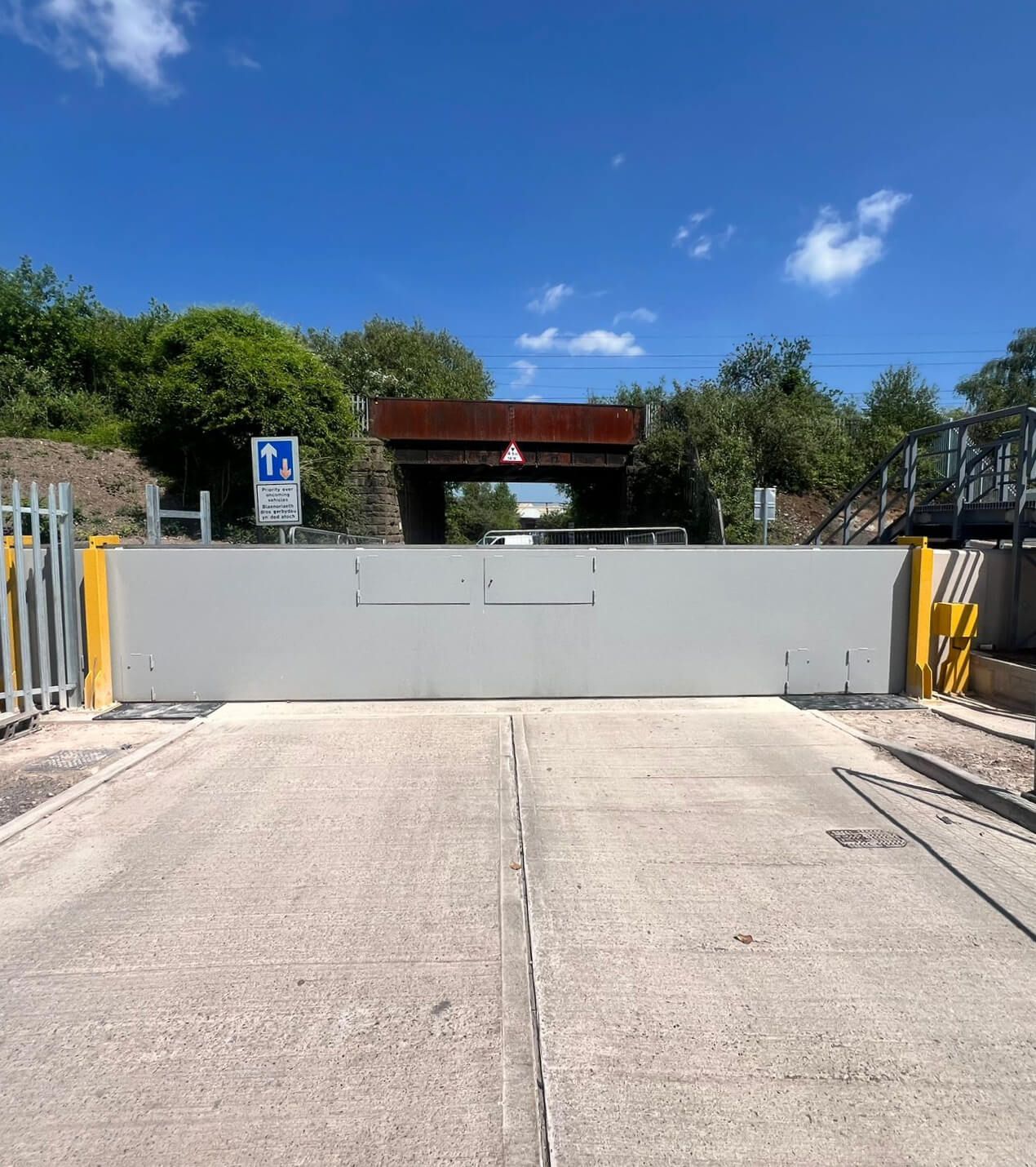
MM Engineering designed and manufactured the sliding flood gate across Corporation Road on the Stephenson Street flood scheme in Newport, delivered by Natural Resources Wales (NRW). The gate is 1.7 m high with a 9 m span. The road carries a high volume of heavy goods vehicles and abnormal vehicles, and the gate was designed for deployment by a single operative in high winds. It is manually operated, and it was flood tested on site.
The scheme
Stephenson Street is a £25m scheme, funded by the Welsh Government and delivered by NRW, that reduces tidal flood risk in Lliswerry on the east bank of the River Usk. Alun Griffiths (Contractors) Ltd built it and Arup designed it. Arup describes it as NRW's largest and most complex flood scheme to date.
The scheme provides about 2 km of raised defences, made up of flood bund, sheet pile wall and reinforced concrete stem walls. Its 700 m of sheet pile wall was installed to a depth of 10 m by silent press-piling. That kept noise and vibration down beside the River Usk, a Special Area of Conservation whose features include shad, a fish sensitive to vibration.
The defences raise protection to a 1 in 200-year standard, meaning a flood with a 0.5% chance of happening in any year, with allowances for sea level rise and the predicted increase in rainfall over the next 50 years. NRW says the scheme reduces flood risk to more than 2,000 homes and businesses. That figure includes climate change. The scheme's case study puts the present-day risk at more than 190 homes and 620 businesses, rising to 1,120 homes and 1,020 businesses by 2070.
Why Corporation Road needed a gate
Corporation Road, the access to industrial premises, passes beneath a railway overbridge on the line of the new defences. Left open, it would give flood water a flow path under the bridge. A wall would close the road, so the scheme closes the gap with a flood gate that stays open for traffic. The gate and its wing walls tie the defence into existing high ground. The gate is closed for maintenance and ahead of anticipated high tides. While it is shut, 0.7 km of new flood relief road between East Bank Road and Corporation Road provides alternative access and emergency egress.
Designing a 9 m gate for a working road
The scheme's published case study records what the gate was designed for:
- a 9 m span at a height of 1.7 m
- a road with a high volume of heavy goods vehicles and abnormal vehicles
- deployment by a single operative, including in high winds
Sliding gates are used on wide openings where a swing or lift gate is not practical. A 9 m swing leaf would sweep a quarter circle 9 m in radius each time it opened or closed, while a sliding leaf travels along the line of the defence and is stored to one side. Size also sets the wind load. The leaf is 10.3 m long and 1.75 m high, so it overlaps the 8.72 m clear opening at both ends. That is about 18 m² of steel for the wind to act on while one operative moves it.
How the gate works
The Corporation Road gate is a single steel leaf that lifts, slides and seals. To move it, the operator first raises the leaf onto four castors with a hand pump. Two hand winches, one to open and one to close, then pull it along a stainless steel guide rail. Once it is in place, the leaf is lowered onto the stainless steel threshold, compressing the base seal.
The leaf weighs almost 2.5 tonnes, but its calculated rolling resistance is about 30 N, roughly the weight of a 3 kg bag. That, with the hand pump and the winches, is what makes a manually operated 9 m gate practical for one person. MM Engineering's standard sliding gate is manually operated up to 6 m wide and 1 m high; larger gates are usually automated.
In a flood, the water presses the leaf against sealing posts fixed to both wing walls, so the flood itself pushes the ends of the leaf onto their seals. The leaf is a matrix of 100 mm S355 steel hollow sections, fully welded between two steel skins. The threshold, guide rail and sealing blades are stainless steel, and the steelwork is blast cleaned and painted to a C5 system for the tidal setting. The gate is designed for a 60-year life.
What the gate puts on the walls
At the design flood, water stands about 1.7 m deep against the closed gate. The calculations take it to 1.725 m, 25 mm above the gate's 1.7 m flood protection height. That is about 15 kN on every metre of the gate's width (unfactored), or roughly 130 kN across the opening, acting about 0.6 m above the threshold.
The wing walls either side were designed to take an even share of that load, and MM Engineering detailed the gate to suit. The leaf seats against sealing posts fixed to both walls, and packing pieces on its dry side limit its movement under load.
The leaf's weight takes a different route. A hinged leaf hangs its weight off its hinge post whenever it is open or moving, and an open leaf catches the wind like a sail. A sliding leaf has no hinges. Its weight goes straight down through its castors and base into the threshold, so the wing walls take the water load but not the leaf's weight. When it is open, the leaf parks alongside the defence between guide posts, which take the wind.
The trade-off is the threshold. It carries the leaf in both positions, so it runs 20 m for an 8.72 m opening, and the part across the carriageway carries the road's heavy goods traffic. The concrete sill beam beneath it was designed for a five-axle articulated lorry with a maximum axle load of 100 kN.
Result
Construction of the 2 km of defences began in February 2023 and finished in spring 2025. The scheme was officially opened in October 2025. It received the Bill Ward Sustainability Award at the 2025 ICE Wales Cymru Awards.
The scheme's case study, written by the project team from NRW, Arcadis and Arup and published by Water Projects Online in July 2025, states: "The gate was manufactured by local Port Talbot-based firm MM Engineering." Its supply chain list credits the design and manufacture of the 9 m floodgate to MM Engineering, and floodgate design assistance to Pebble Engineering Ltd.
MM Engineering sizes each gate from the clear opening, the flood level and the loadings it must carry, traffic included. It also supplied flood gates, flood glazing and flood barriers for the Belfast Tidal Flood Alleviation Scheme. See our sliding flood gates, or talk to our engineering team about a wide opening on your site.
FAQ
What loads does a sliding flood gate put on the wing walls?
For a lift-and-slide gate, mainly the water load. At Stephenson Street that is about 15 kN per metre of width at the design flood (unfactored), roughly 130 kN across the 8.72 m opening, and the wing walls were designed to share it evenly. The leaf's weight goes down into the threshold rather than into the walls, and there's no open leaf acting as a sail on a hinge post.
Can one person close a 9 m sliding flood gate?
Yes, if it is designed for it. The Stephenson Street gate was designed for deployment by a single operative, including in high winds. A hand pump lifts the leaf, which weighs almost 2.5 tonnes, onto castors, and hand winches roll it closed. Its calculated rolling resistance is about 30 N.
Can a sliding flood gate threshold carry HGV traffic?
Yes, if it is designed for it. At Stephenson Street, where Corporation Road carries a high volume of heavy goods vehicles, the concrete sill beam under the gate's 20 m threshold was designed for a five-axle articulated lorry with a maximum axle load of 100 kN.
When is a sliding flood gate better than a swing gate?
Where the opening is wide, or there is no room for a leaf to swing, such as across a road or an underpass. A sliding leaf travels along the line of the defence and is stored to one side, so it needs no swing space, and its weight goes into the threshold instead of hanging off a hinge post. In return, it needs a level run-out beside the opening about as long as the leaf, with the threshold continuing along it.
Was the Stephenson Street gate leak tested?
Yes. It was flood tested on site with 1.7 m of water held in a temporary bund against the gate, including 48 hours at full depth. Every stage passed, and the worst hour measured, 37 litres, was about a quarter of the 136 litres allowed on the signed test record.
Your browser is out-of-date!
Update your browser to view this website correctly. Update my browser now